Remembering Journalist Walter Liggett on the 90th Anniversary of His Assassination
… and the Long History of Organized Crime and Corruption in the City of Minneapolis.

In recent news, there have been headlines about organized crime and corruption in Minneapolis, Minnesota. Some people on social media have expressed their astonishment that such activities could happen in a city better known for Prince and Hubert Humphrey … but, that is because the decades-long history of organized crime and corrupt public officials has been hidden, suppressed and critics harassed and even killed. Minneapolis has a record of criminality and public malfeasance that rivals the better-known record of Chicago, it’s just not as well known.
Ninety Years Ago on December 10th, 1935, journalist Walter Liggett was machine-gunned to death in front of his wife and daughter in an alley behind his apartment building, Walter Liggett was one of three journalists murdered by mid-century mobsters in the City of Lakes. For much of its existence, Minneapolis and its twin city, Saint Paul were notorious for being a safe haven for organized crime.
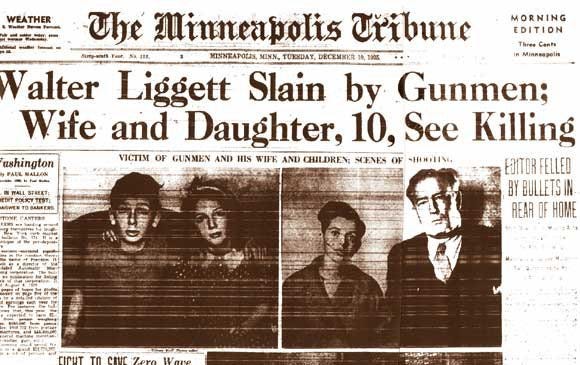
James Shiffer wrote the following in the Star Tribune”s Whistleblower blog, July 25th, 2008:
On the eighth of July, Marda Liggett Woodbury, a retired library director, died in California. She was 83. News of her death didn’t reach our newsroom until some time later, and I only heard about it this week.
I didn’t know Ms. Woodbury. I spoke to her only once, last year, when I called her after reading her book. But I found myself saddened, because she had been a living link, perhaps the last witness, to a terrible chapter in the history of Minneapolis.
Between 1934 and 1945, three journalists were murdered in Minneapolis. All of them were gunned down on the street in gangland-style slayings. No one was ever punished in their deaths of Howard Guilford, Walter Liggett and Arthur Kasherman. Over the years, the city salved its conscience by remembering these newspapermen as so scurrilous in their methods and reckless with their associations that they deserved what they got. In fact, each of them, with varying degrees of credibility, self-interest and skill, was attempting to expose the rampant corruption and gangster rule virtually ignored by the dailies, the predecessors of the newspaper I work for now. Guilford, Liggett and Kasherman were the bloggers of their day, attacked by the mainstream politicians and media alike.
In 1935, Marda Liggett Woodbury was 10 years old when she saw her father, Walter Liggett, shot to death behind the family’s apartment in Stevens Square. Liggett, editor of the Midwest American, was a vocal critic of Gov. Floyd B. Olson, whom he accused of tolerating corruption and betraying his radical principles. His daughter testified at the February 1936 trial of the notorious Minneapolis gangster charged in his death, Isadore “Kid Cann” Blumenfeld. That’s when her picture shown above was taken, her eyes glaring into the news photographer’s lens with a startling ferocity.
Blumenfeld was acquitted and went on to a long and mostly uninterrupted career in organized crime. Walter Liggett’s family moved away from Minnesota. Sixty years later, in 1998, the University of Minnesota Press published Marda Liggett Woodbury’s book, “Stopping the Presses: the Murder of Walter W. Liggett”. It makes a persuasive case that her father was assassinated because of his political beliefs and his willingness to speak out about them. It was the first step, and not the last, of historians re-evaluating the meaning of the three murders.
... it’s a good column, available on the Internet Archive.
Another excellent book about that period in Minneapolis history is Fred Friendly’s Minnesota Rag, a book about the landmark U.S. Supreme Court case, Near vs Minnesota regarding Minnesota’s “Gag Law” which restrained journalists from publishing critical articles about the cozy relationships between public officials and gangsters:
In a Minneapolis newspaper called The Saturday Press, Jay Near and Howard Guilford accused local officials of being implicated with gangsters. Minnesota officials sought a permanent injunction against The Saturday Press on the grounds that it violated the Public Nuisance Law because it was malicious, scandalous, and defamatory. The law provided that any person “engaged in the business” of regularly publishing or circulating an “obscene, lewd, and lascivious” or a “malicious, scandalous and defamatory” newspaper or periodical was guilty of a nuisance, and could be enjoined from further committing or maintaining the nuisance. The state supreme court upheld both the stemporary injunction and the permanent injunction that eventually issued from the trial court.
Basically, the corrupt Minneapolis officials would get wind of an article they didn’t like in a muckraking, independent newspaper and order the police to grab copies off newsstands before anyone could read them. Describing this action as “Prior Restraint”, the U.S. Supreme Court struck down the state court’s ruling:
In an opinion authored by Chief Justice Charles Hughes, the Court held that the statute authorizing the injunction was facially unconstitutional, meaning the decision was based on an analysis of the law’s general applications, not the specific context of this case. The Court held that the statutory scheme constituted a prior restraint and hence was invalid under the First Amendment.
So, how bad was the corruption that it needed to be hidden from the public? Very, very bad. The enormous scale of official corruption, almost from the very founding of the city, is difficult to imagine. In his turn-of-the-century book, Shame of The Cities, Lincoln Steffens wrote about one notorious mayor of Minneapolis, Doc Ames:
Immediately upon his election, before he took office (on January 7, 1901), he organized a cabinet and laid plans to turn the city over to outlaws who were to work under police direction for the profit of his administration. He chose for chief his brother, Colonel Fred W. Ames, who had recently returned under a cloud from service in the Philippines. But he was a weak vessel for chief of police, and the mayor picked for chief of detectives an abler man, who was to direct the more difficult operations. This was Norman W. King, a former gambler, who knew the criminals needed in the business ahead. King was to invite to Minneapolis thieves, confidence men, pickpockets and gamblers, and release some that were in the local jail. They were to be organized into groups, according to their profession, and detectives were assigned to assist and direct them. The head of the gambling syndicate was to have charge of the gambling, making the terms and collecting the “graft,” just as King and a Captain Hill were to collect from the thieves. The collector for women of the town was to be Irwin A. Gardner, a medical student in the Doctor’s office, who was made a special policeman for the purpose.
The crooked police preyed on the honest, unwitting citizens of Minneapolis:
In a general way all this business was known. It did not arouse the citizens, but it did attract criminals, and more and more thieves and swindlers came hurrying to Minneapolis. Some of them saw the police, and made terms. Some were seen by the police and invited to go to work. There was room for all. This astonishing fact that the government of a city asked criminals to rob the people is fully established. The police and the criminals confessed it separately.
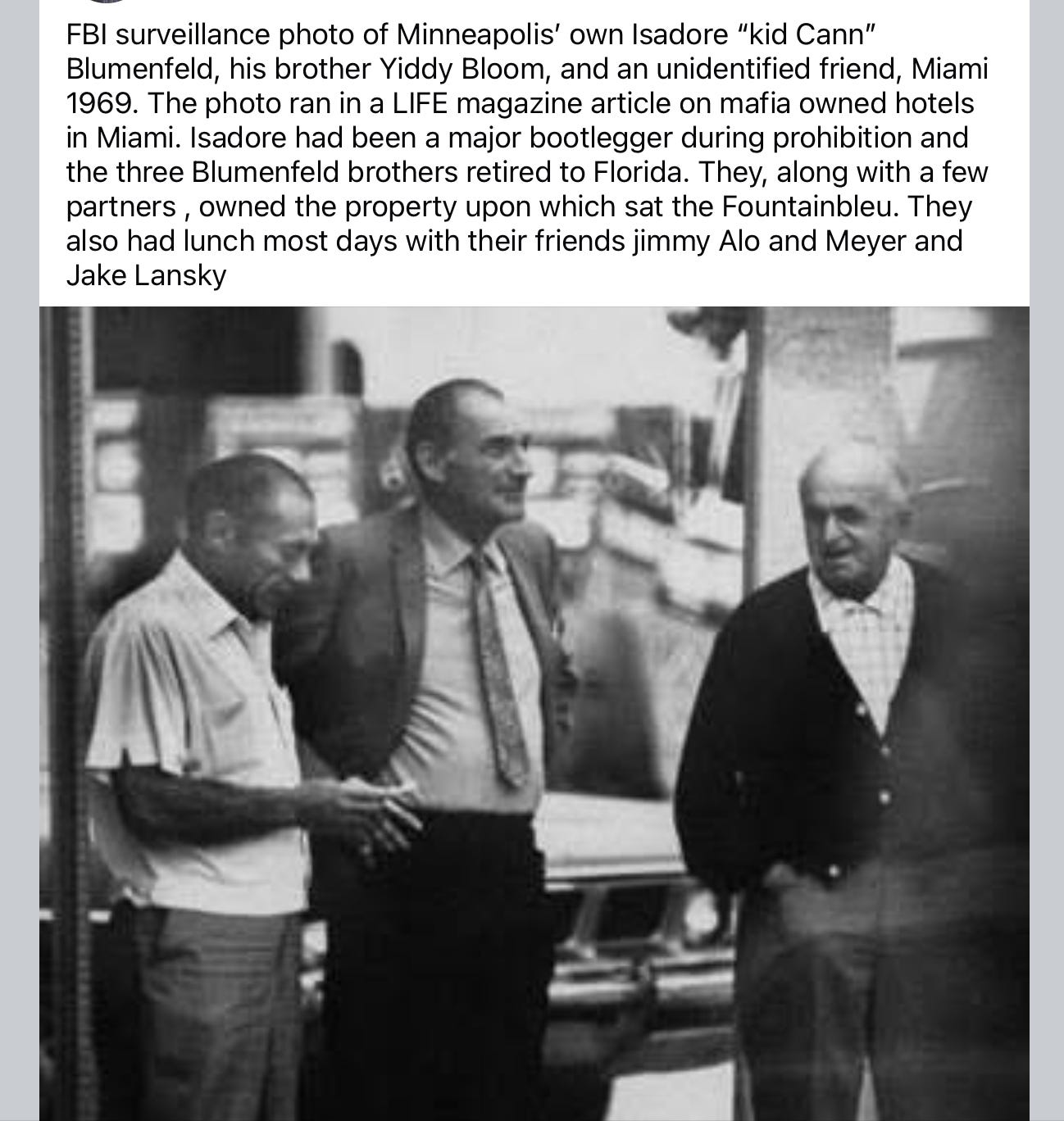
The list of notorious gangsters who did business in the Twin Cities is a long one. Isidore Blumenthal, alias “Kid Cann” and his brother Yiddy Bloom ran the rackets for many years. Kid Cann was suspected of ordering the hit on Liggett, but was acquitted. Kid Cann was also instrumental in tearing up and scrapping the much beloved Twin Cities Rapid Transit line. Wikipedia has a good article on Kidd Cann.
Wikipedia also has a good article on David “Davie the Jew” Berman, a gangster who ran the gambling rackets in Minneapolis and later Las Vegas. His daughter, Susan Berman wrote a book worth reading about her dad and his legacy titled Easy Street.
I doubt that Minneapolis will ever give up its time-tested tradition of corruption. When I lived there, I attended the trial of a City Councilman convicted of corruption. I also reported on and sketched at the trial of Tom Petters, who ran a Ponzi scheme that defrauded investors to the tune of $3.6 billion. Tom and his partner, Frank Vennes Jr. donated money to prominent politicians of both parties, including a bunch of presidential candidates.
If you want to take a deep dive into the notorious history of Minneapolis I recommend Dara Moskowitz Grumdahl’s excellent 1995 City Pages article titled Minneapolis Confidential (archived on the Wayback Machine).
I also want to mention Walter Liggett’s excellent book The Rise of Herbert Hoover. You can find the book on the Internet Archive.
Have the Somalis got a sponsor do you figure or is all of their own making?
WOW! What an interesting post! With all the news of the corruption in that state with the Somali situation, it underlines the corruption that has always been a part of American politics and culture. Keep up the good work!